

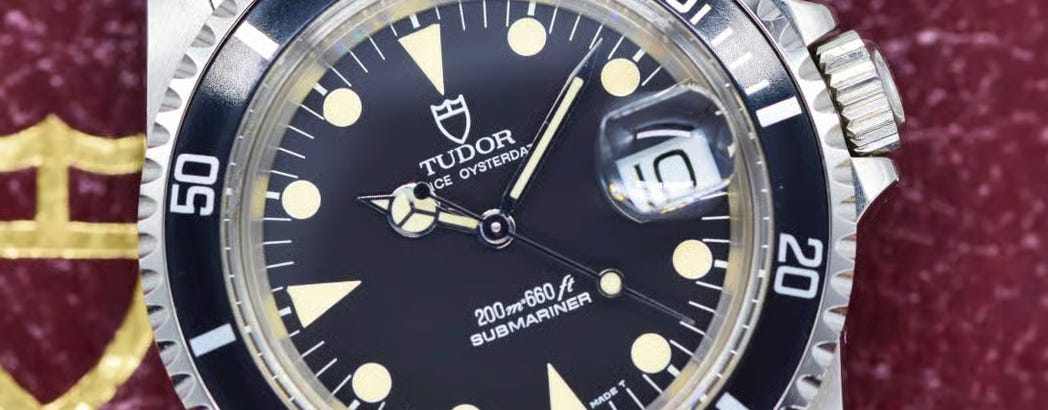
Your truly is quickly developing an obsession with the Tudor Submariner, obsession that manifests itself in way too many visits to Tokyo’s vintage watch spots. As expected none of these visits ends up with a purchase of any watch, because the more I dig deep in this model history, the more I convince myself I haven’t found yet the Right One.
But how deep can you possibly dig in to the history of this model? A lot, turns out. So much to make this high level overview a multi-part series.
A Tool Watch for the Masses
The Tudor Submariner, launched in 1954, became the ultimate expression of Hans Wilsdorf’s Tudor philosophy: not just a budget alternative to the Rolex Submariner, but a professional instrument that was externally indistinguishable from its expensive sibling: a Rolex Oyster case, Triplelock crown and Rolex branding on the caseback, crown and bracelet.
The cost saving happened inside the watch case, where Tudor adopted third-party calibres, primarily from Fleurier and later ETA.
In this series we will focus on “full size” Submariners, started with the reference 7922 with a 37mm case size, to the “gold standard” of 39mm, till the very last Submariner 79190 at 40mm.
Foundation: Tudor 7922, 7923, 7924
The story begins with the “Small Crown” and “Big Crown” models of the mid-1950s. The very first reference, the 7922 (1954 - “Small Crown”), featured a 37mm Oyster case - a standard professional size for the time, the same of the Rolex 6204 introduced just one year before.
The dial shows the Tudor “Small Rose” logo, Mercedes hour hand and lollipop seconds hands - trademarks of early Tudor Submariners. The water resistance is 100 meters with no crown guards.
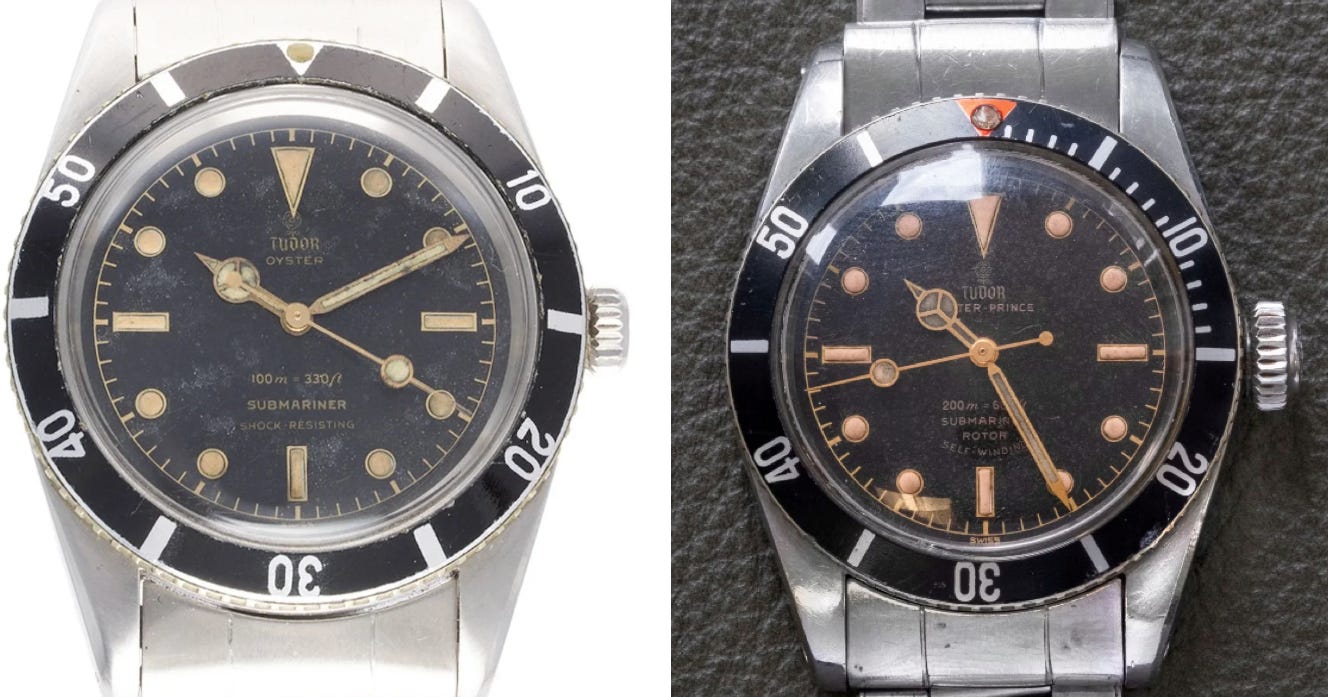
After this initial release, Tudor substantially redesigned the Submariner launching the reference 7924 “Big Crown” in 1958. While the novice might feel the only difference from the 7922 was the bigger crown, the new reference had a substantially thicker mid-case, a thicker acrylic crystal and a redesigned case back in order to achieve a 200 meters water resistance.
The updated specs meant also that this model was the first issued to the French Marine Nationale, and the feedback from the army divers directly led to the creation of new (and bigger) models.
Both the 7922 and 7924 adopted the Calibre 390, a 17-jewel automatic movement based on a Fleurier ebauche and then modified by Tudor. A compact and reliable movement beating at the low frequency of 18,000 beats per hour, it was a good and pragmatic solution to power 37-39mm divers.
Between the two models, we also have the manual Tudor 7923 which is somehow an oddity as the only manual-wind Submariner ever produced by Tudor or Rolex. The case is very similar to the 7922, slightly thinner due to the use of the manual ETA 1182 movement. Unsurprisingly, a manual diver watch never became popular among professional, to the point that collectors thought for decades that the 7923 was a “Frankenwatch” until Tudor confirmed it in their archives as a legitimate, rare production model (that once sold for 99,999$ on eBay)
The Definitive Early Submariner: Tudor 7928
In 1959, Tudor introduced the Reference 7928, with a bigger 39mm case to improve overall legibility; this is considered the final state of the first generation of Submariners, remaining in production until 1968.
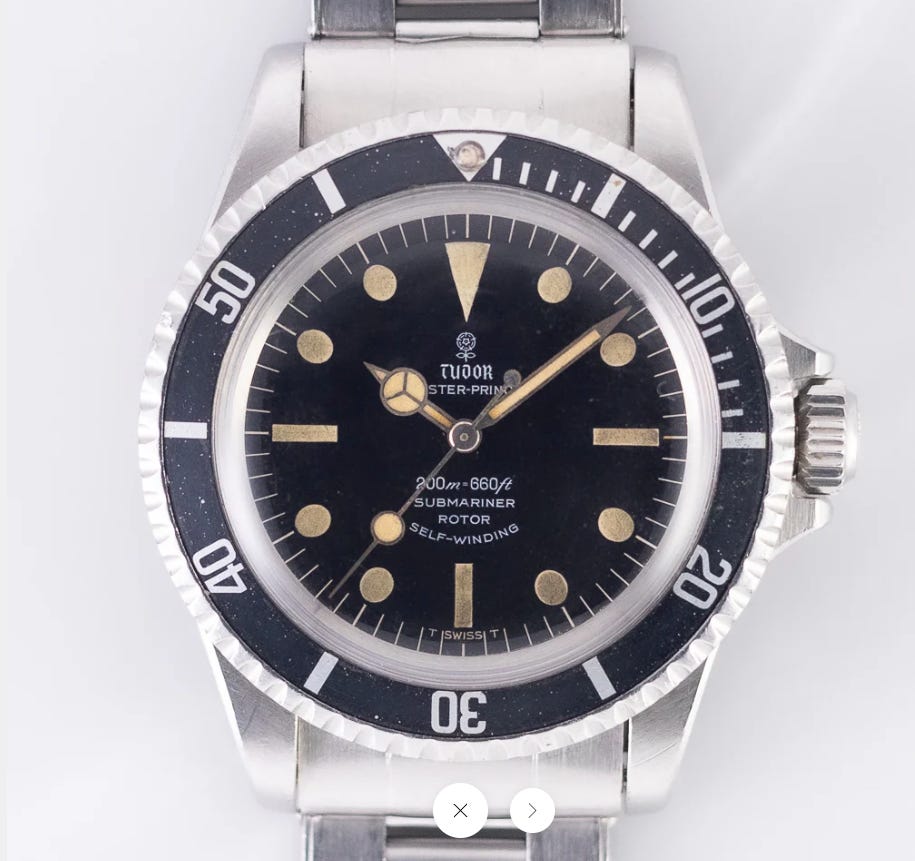
Still with the Tudor “Small Rose” logo, Mercedes hour hand and lollipop seconds hand, this with the introduction of crown guards assumes the most classic Submariner look.
During the life of the 7928 several evolutions of the crown guards designs can be seen: Square Crown Guards (thick and blocky, very rare), Pointed Crown Guards (so called “Cornino” ending in a sharp point), Rounded Crown Guards (the final more roundy evolution that was the standard for the following 30 years).
Finally, also the dial experienced small evolutions in the decade of production. During this period, Tudor always used the “Small Rose” logo, but early models had gilt (yellow/gold colored) printed text and chapter ring, while later model have white/silver printed text and chapter ring.
Between 1963 and 1964 we also have the switch from Radium lume to Tritium lume. During the transition some small markers that are sought after by collectors appear: a small horizontal line over the 6 o’clock marker to identify model with lower-radiation Radium (or a very early Tritium mix), and a dot under the 6 o’clock marker to identify the early Tritium dials.
Despite the numerous aesthetic changes to its dial and crown guards, the Reference 7928 adopted the same Calibre 390 throughout its entire lifespan.
(to be continued)