

Heuer pre-Monza
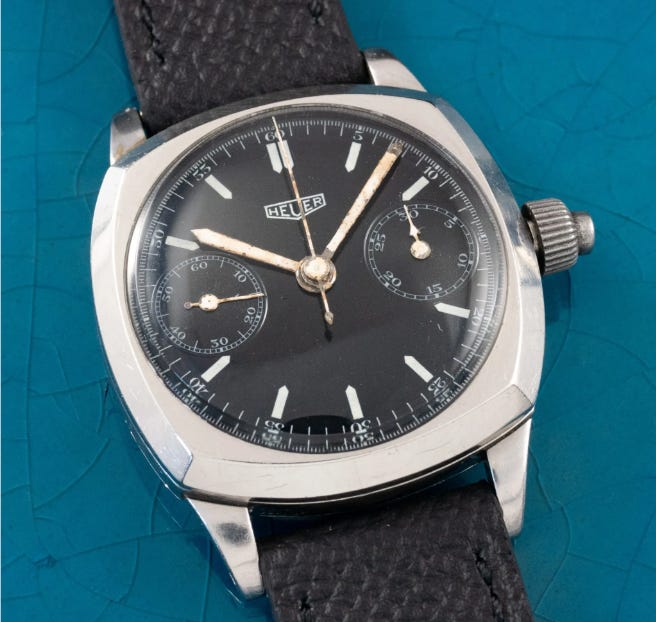
Often the first watch to be mentioned in the Monza lineage is a cushion-cased monopusher chronograph produced in the 1930s. This watch, even though not named Monza, is important in the lineage of this model as its shape inspired the Monza re-editions of early 2000s. Very compact in size (as the times required), with a case of around 33mm, two registers and a single pusher, it was using a single-button chronographic movement derived from the Valjoux 13.
Heuer Monza, 1976
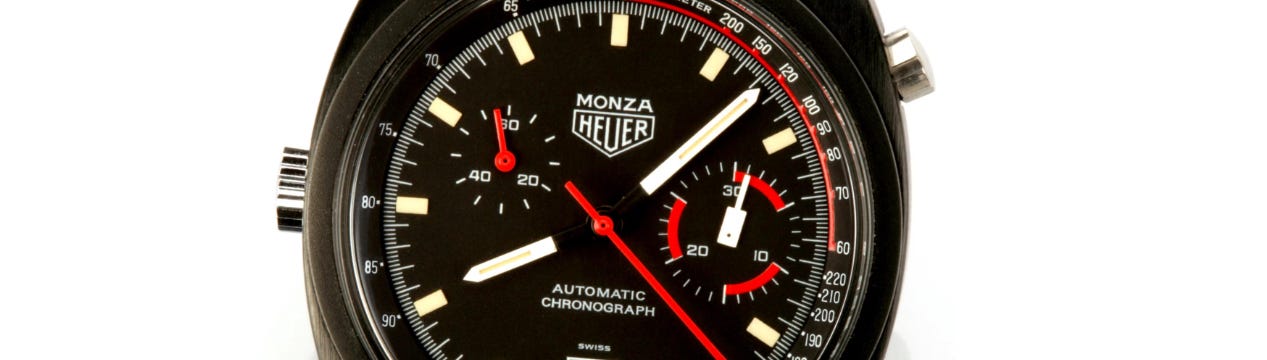
The first Heuer Monza was launched in 1976. Just in 1971, Heuer had become the first watch brand to sponsor an entire Formula 1 team, and developed this celebration piece to commemorate the Austrian Formula 1 driver Niki Lauda third-place finish in the Italian Grand Prix at the Autodromo Nazionale di Monza in 1975, which also secured his first Drivers’ Championship title.
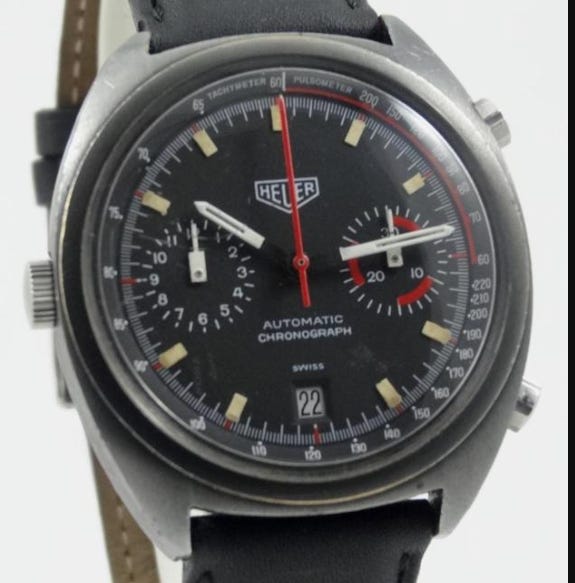
The 1976 Monza’s case had a PVD matte black coating and was powered by the Calibre 15 automatic chronograph, a descendant of the Calibre 11 and of the Project 99, who produced one of the first automatic chronograph calibres in 1969.
The 1976 Monza was historically important because it was Heuer’s first PVD watch with a black esthetic that was in vougue in the 1970s, however it was a relatively unsuccessful release. While more affordable than the contemporary Carrera (thanks to the Calibre 15), it suffered from the competition of quartz watches and was eventually discontinued in the 1980s.
2000 re-edition: CR2110 reference
Following the success of the 1996 Carrera re-edition, TAG Heuer (as it was called after the TAG Group bought a stake in Heuer in 1985) began actively looking at the historical Heuer catalog for new (old?) ideas in an attempt to appeal to enthusiasts interested in the brand’s chronograph heritage.
The result was the CR2110, released around year 2000, which interestingly did not re-issue the tonneau case of the 1976 Monza, nor used the PVD coating, going back (as we noticed before) to the shape of the 1930s monopusher. Case dimensions remained very compact at 38mm, adopting the TAG Heuer Calibre 17 based on the ETA 2894-2.
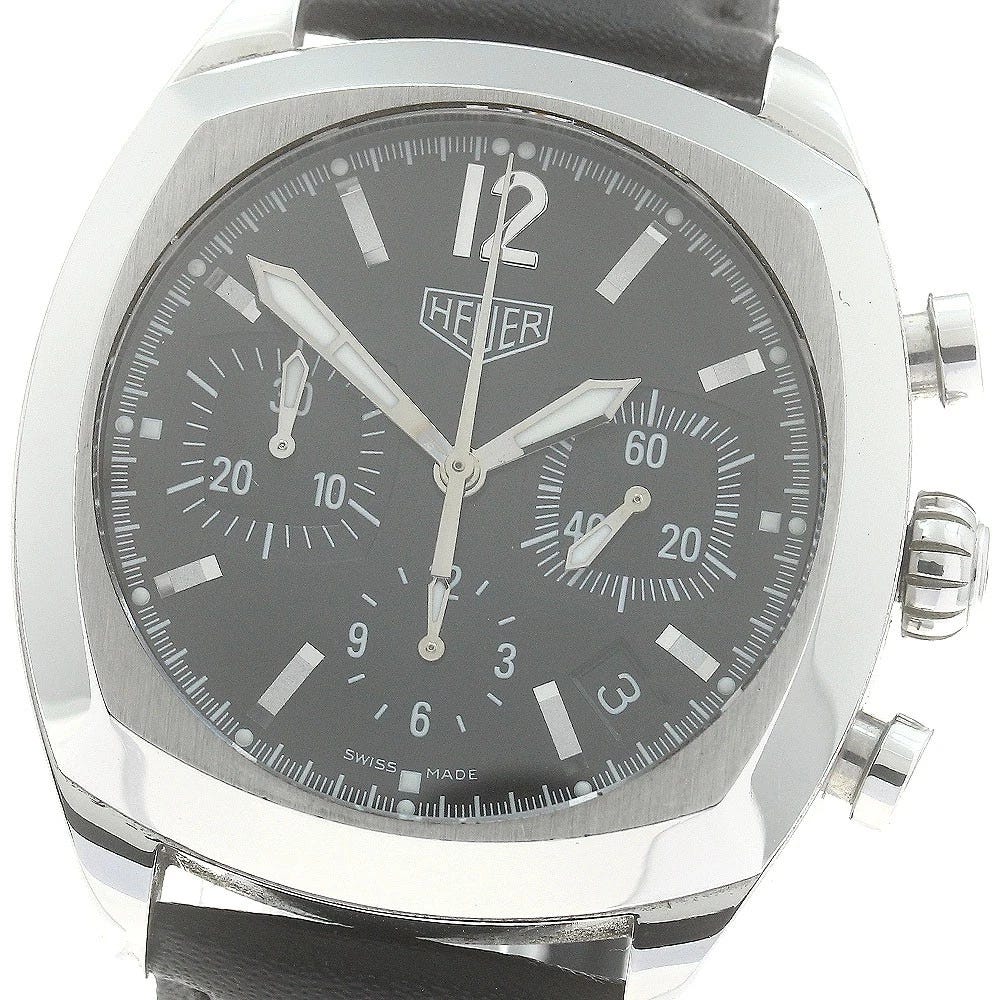
In line with the vintage inspiration, the original CR2110 and CR2111 (silver dial) only had the “Heuer” logo on the dial, while later the CR2113 (black dial) and CR2114 (silver dial) had the “TAG Heuer” logo with the “Monza” name on the dial.
Tag Heuer Monza Calibre 38 - CR5110
The next generation of the TAG Heuer Monza (ref. CR5110) has a cushion case similar to the CR2110, just marginally bigger at 39.5mm and 14mm in height. However it looks and feels significantly more premium than the previous version thanks to the guilloché-like dial divided in sectors that brings out subtle textures shifting with every angle.
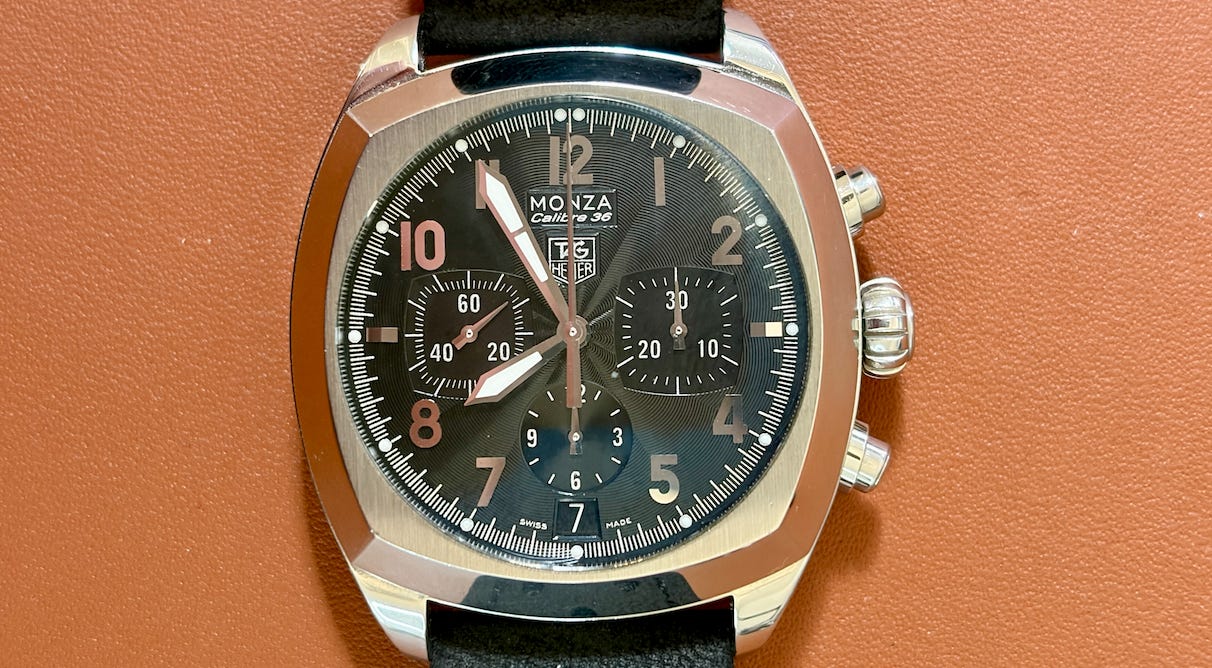
Prominent in the dial, between the “Monza” name and the “TAG Heuer” logo, you see “Calibre 36” in italics. That is a premium calibre based on the Zenith El Primero 400, with a 36,000 vibration-per-hour beat rate, a 50-hour power reserve and a column-wheel mechanism. The movement is also well-decorated with arguably a better finish than contemporary Zenith watches using the same calibre.
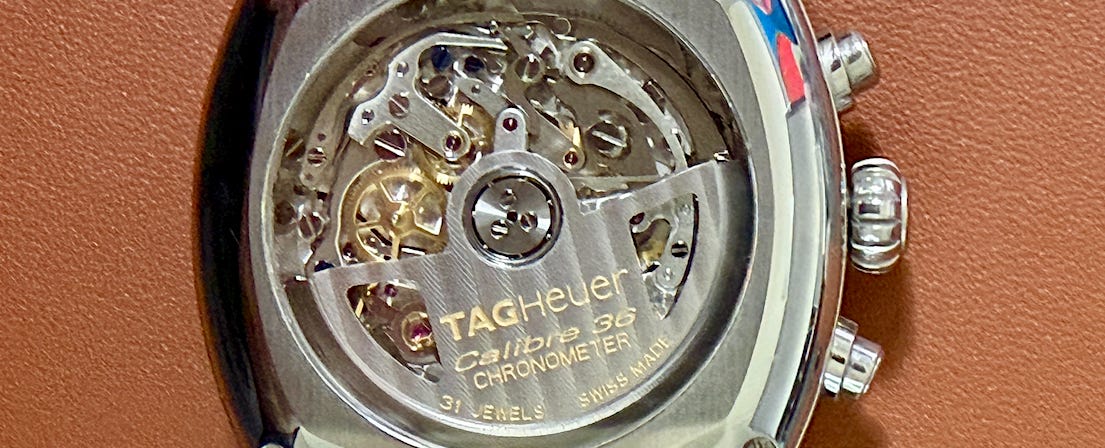
It might seem counterintuitive that TAG Heuer, a pioneer who developed one of the first automatic chronograph movements with Project 99, chose to utilize a direct competitor’s caliber. However, by the early 2000s, since both Zenith and TAG Heuer belonged to the LVMH Group, it likely made strategic sense to incorporate a premium movement to boost TAG Heuer’s image following the challenges of the 1990s.
40th anniversary edition: CR2080
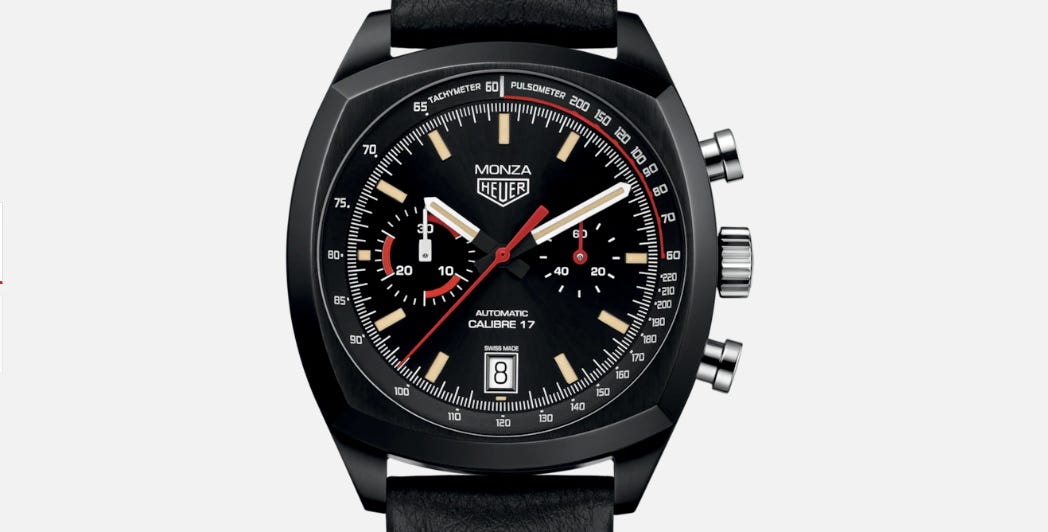
The Tag Heuer Monza CR2080.FC6375, released in 2016, is arguably the most successful modern interpretation of the Monza name. Launched as a limited edition at Baselworld to commemorate the 40th anniversary of the original 1976 model, the CR2080 combines the best of the Monza’s two design histories: the black PVD coating of the original model, and the cushion case shape of the 2000s re-editions, stretched to a more modern 42mm size. The case is made from lightweight Grade 5 Titanium and coated with black matte finished Titanium Carbide for better durability. In a nod to purists, the dial features only the historic “HEUER” logo.
The watch is powered by the TAG Heuer Calibre 17 automatic movement (again based on the ETA 2894-2); maybe a step back from the Calibre 36, but more true to the watch vintage origins.